Centripetal: The Knowledge That Converges
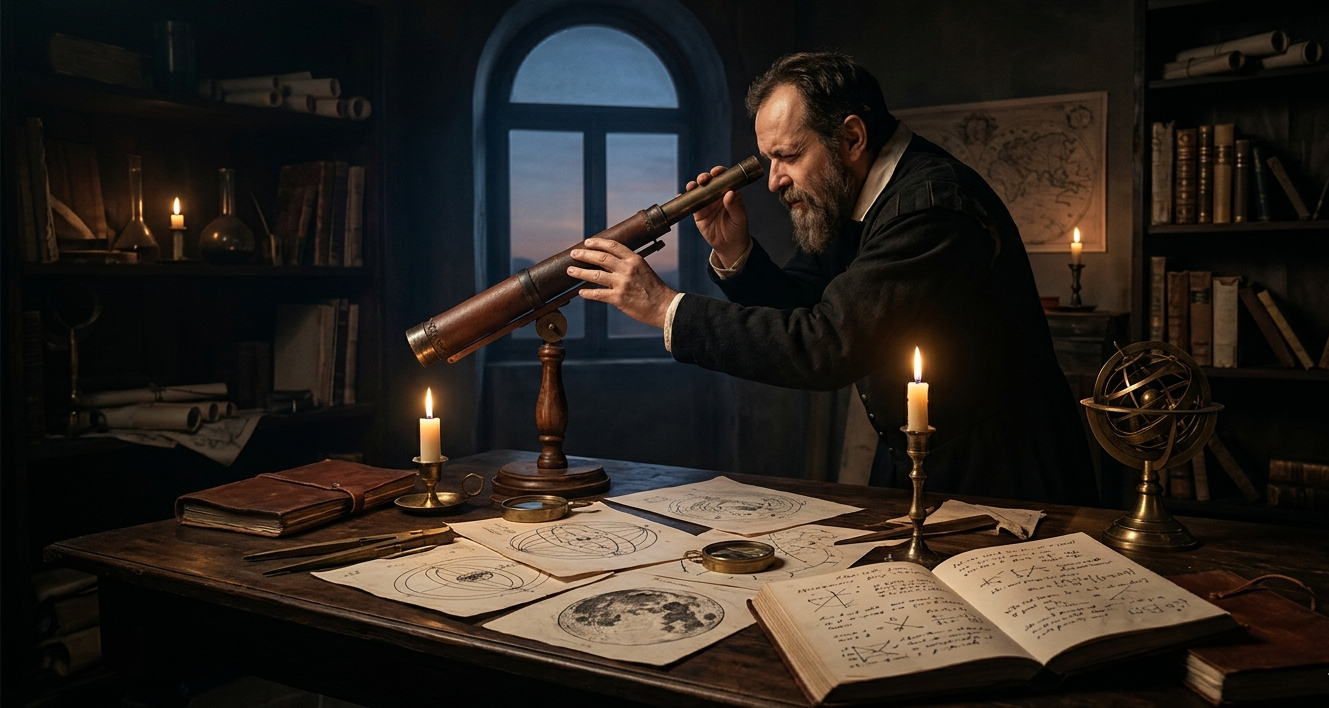
Every major intellectual revolution has a Galileo moment: when the object of inquiry becomes clear, the method takes shape, and the formal language adequate to carry the new questions is still being forged. Newton and Leibniz didn't find calculus waiting for them. The questions Galileo opened called it into existence.
Geneosophy is in that moment now. The object of inquiry is identified, XI, the generative ground beneath all conceptual and objective experience, the conditions of possibility for any concept to manifest at all. The method is established. And the formal expressive framework that will allow these discoveries to be shared across minds, accumulated across time, built into a genuine intellectual community, that framework exists in its infancy and is being refined.
[Part 1] | [Part 2] | [Part 3] | [Part 4] | [Part 5] | [Part 6]
Practitioner: So Geneosophy isn't just a different theory. It's a different direction of inquiry.
Philosopher: Exactly. The scientific method moves centrifugally. Every answer generates new objects, new relations, new disciplines. Knowledge expands outward, away from any center, indefinitely. This is enormously productive. It is also, structurally, incapable of producing a whole.
Practitioner: Because wholeness isn't an object you can study.
Philosopher: It's not an object at all. Which is precisely why the scientific method cannot reach it, not because it isn't rigorous enough, but because its rigor requires fixing objects, and fixing objects requires making cuts, and making cuts destroys the very wholeness you were hoping to illuminate.
Practitioner: And Geneosophy moves inward instead.
Philosopher: Centripetally. Every approach to XI, phenomenological, biological, developmental, cultural, is approaching the same source from a different angle. The angles multiply. The object remains one. You cannot subdivide XI without ceasing to study XI. The holism is not a methodological choice. It is enforced by what XI is.
Practitioner: Which means the knowledge it produces is a different kind of knowledge entirely.
Philosopher: It means the knower is transformed by it, not just informed. Scientific knowledge can be distributed across journals, institutions, specialists, now AI systems. That is its great strength. Geneosophy's knowledge is not acquiring information about something external. It is a being becoming more fully aware of its own generative ground. The process will take years.
Practitioner: You said this will take years. That feels like a concession. A way of deferring the hard question of whether it can actually be done.
Philosopher: It's the opposite of a concession. It's a precise location. We know where we are.
Practitioner: Which is?
Philosopher: Where Galileo was. The object of inquiry has been identified, XI, the generative ground beneath conceptual and objective experience, the conditions of possibility for any concept to manifest. The method of inquiry is established. And a formal expressive framework, the tool that allows what is discovered to be communicated in third-person terms, shared across minds, accumulated across time, is being constructed; the equivalent of mathematics.
Practitioner: But Galileo had mathematics on day one.
Philosopher: Exactly. And even his mathematics wasn't sufficient. When the questions Galileo opened became precise enough, Newton and Leibniz had to invent calculus. The existing formal language couldn't carry the new content. The questions themselves called a new mathematics into existence.
Practitioner: And Geneosophy needs something equivalent.
Philosopher: It needs a formal expressive framework adequate to XI. Which is a specific and extraordinary challenge, because XI is the ground of all first-person experience. Making it available for third-person communication, for genuine intersubjective inquiry, requires tools that exist in their infancy. They are being built. But it will take years to perfect them. And it will take a critical mass of people becoming fluent with them before the inquiry can move at the pace a genuine intellectual community makes possible.
Practitioner: So the years aren't vagueness. They're the time required to perfect the instrument.
Philosopher: Every major intellectual revolution has had this interval. The moment when the question became precise enough to be asked, but before the tools existed to answer it systematically. That interval is not a weakness. It is the most creative period in the life of any new inquiry.
Practitioner: And you think Geneosophy is in that interval now.
Philosopher: I think it has just entered it. Which means the work ahead is not refinement of a mature framework. It is the harder and more original work of perfecting the formal language that can carry XI into shared inquiry. That is where Leibniz and Newton were. It is where Geneosophy is.
Practitioner: And at the end of it?
Philosopher: Not at the end, all along it. What becomes possible is a comprehensive understanding of human nature. Not a reductive one. Not a fragmented one. Not one that defines humanity downward to fit the machines we've built. But one that begins and ends with the question that was always the most important: what is it to be the kind of being that can ask what it is?
Practitioner: (pause) That's a question AI will never ask about itself.
Philosopher: No. Because asking it genuinely requires having a self whose ground is unknown to it. That is not a deficiency to be engineered away. It is the very condition that makes the inquiry possible. And it is what Geneosophy, finally, proposes to take seriously.